
Handicapping Reconciliation Legislation in 2026

Updated: Jun 4
Republicans in the House and Senate have agreed to use the budget reconciliation process this year to accomplish major goals without the need for Democratic votes. While that fact is now clear, it is yet to be decided how many bills there will be, what policies will be addressed, how much money will be spent, and when these votes will all take place.
Assessing the Top Policy Priorities
Republicans have a large laundry list of priorities for reconciliation. In order to predict the details of reconciliation, it is important to identify the remaining GOP priorities for the year.
Three years of appropriated funding for Immigration and Customs Enforcement (ICE) and Customs and Border Protection (CBP).
Providing supplemental funding for defense and war operations.
SAVE America Act components and money for states that enact voting reform.
Tightening eligibility and reducing fraud for means tested benefits.
Reducing federal funding for sanctuary cities.
Additional tax cuts.
Health care affordability proposals, including direct subsidies to patients.
Policy Priorities Will Be Addressed Through Multiple Bills
The more policies included in a reconciliation bill, the more difficult it will be to pass. The House (217-214-1) and Senate (53-47) Republican majorities are slim and the caucus is diverse. In order to ensure that CBP and ICE funding is enacted, the plan is to move those policies first and as part of a very thin package. Other priorities will move in a second reconciliation tranche this year. There may even be an attempt to pass a bipartisan spending bill after military action against Iran wraps up.
Here’s a look at an illustrative series of bills that Congress could consider to pass its priorities.
Concurrent Budget Resolution
Before anything gets started, the House and Senate must pass identical budgets with instructions that committees produce reconciliation bills that meet spending targets. This is step one. Both budget committees hope to move quickly before the end of April. Congress can approve either a budget for FY 2026 or FY 2027 since neither have yet passed.
H.R. 1 used an FY 2025 budget as a legislative vehicle.
First Reconciliation Bill of Calendar Year 2026
The first bill will likely be narrowly focused on providing three years of mandatory appropriations for ICE and CBP, which were excluded from the recent Department of Homeland Security (DHS) spending deal. By focusing on small goals, the hope is the bill can move quickly. It will likely cost in the range of $90 to $120 billion (more below). This will be the easier of the two bills, and the President has said that he wants it sent to his desk by June 1, 2026. Congress is set to recess on May 21, 2026.
Second Reconciliation Bill of Calendar Year 2026
Most of the big-ticket policy issues that Republicans want to pass before the midterms will likely be part of a second reconciliation bill after ICE and CBP are funded. This means voting reform dollars, spending cuts, defense spending, and affordability measures will be pushed into the summer before the August recess. This second bill will be much larger and thus face a much more perilous path to enactment.
Potential Bipartisan Spending Bill
Given the difficulty of a second reconciliation bill this summer, Republicans could pivot and try to pass spending priorities like defense spending in a bipartisan bill before the midterms. Democrats also have spending priorities which could be added to garner votes. It is highly unlikely that Democrats would vote for defense while the conflict in Iran continues.
Estimating Potential Costs of Certain Policies
One variable that will impact the likelihood of passing reconciliation is the total cost associated with the bills. Conservatives may ask for some spending to be offset with cuts elsewhere, and those cuts in turn could dissuade moderate support. Many costs will come in the form of mandatory appropriations and grants. Below is a first attempt to estimate those levels.
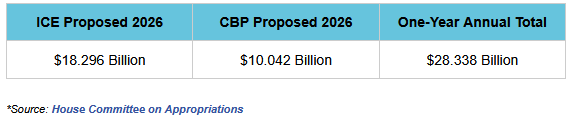
Three Years of Appropriations for ICE and CPB - $90 to $120 Billion
Based on the proposed 2026 spending levels ($28 billion) and standard annual increases, three years of funding for ICE and CBP could cost somewhere between $90 billion and $120 billion.
Funding for States to Implement Voting Reforms - $40 to $100 Billion
The level of funding required to entice states to enact voting reforms is highly speculative. In some cases, Republicans may actually seek to cut spending in order to enact voting reforms. Under that scenario, the bill could deny mandatory spending if reforms are not enacted. There are many parliamentarian questions to be answered as well. We estimate the amount necessary would vary by state size and would range from $500 million - $5 billion.
Supplemental Spending for Defense - $350 Billion
Last week, the Office of Management of Budget (OMB) released the President’s FY 2027 budget request for Congress. In order to reach President Trump's objective of spending $1.5 trillion on defense annually, the bill includes (Table S-2) a base discretionary increase of $251 billion and a one-time, mandatory supplemental defense spending request of $350 billion. The second amount would come as a part of reconciliation or a stand-alone supplemental bill.
Funding for States to Implement Voting Reforms - $40 to $100 Billion
The level of funding required to entice states to enact voting reforms is highly speculative. In some cases, Republicans may actually seek to cut spending in order to enact voting reforms. Under that scenario, the bill could deny mandatory spending if reforms are not enacted. There are many parliamentarian questions to be answered as well. We estimate the amount necessary would vary by state size and would range from $500 million - $5 billion.
Supplemental Spending for Defense - $350 Billion
Last week, the Office of Management of Budget (OMB) released the President’s FY 2027 budget request for Congress. In order to reach President Trump's objective of spending $1.5 trillion on defense annually, the bill includes (Table S-2) a base discretionary increase of $251 billion and a one-time, mandatory supplemental defense spending request of $350 billion. The second amount would come as a part of reconciliation or a stand-alone supplemental bill.


Comments